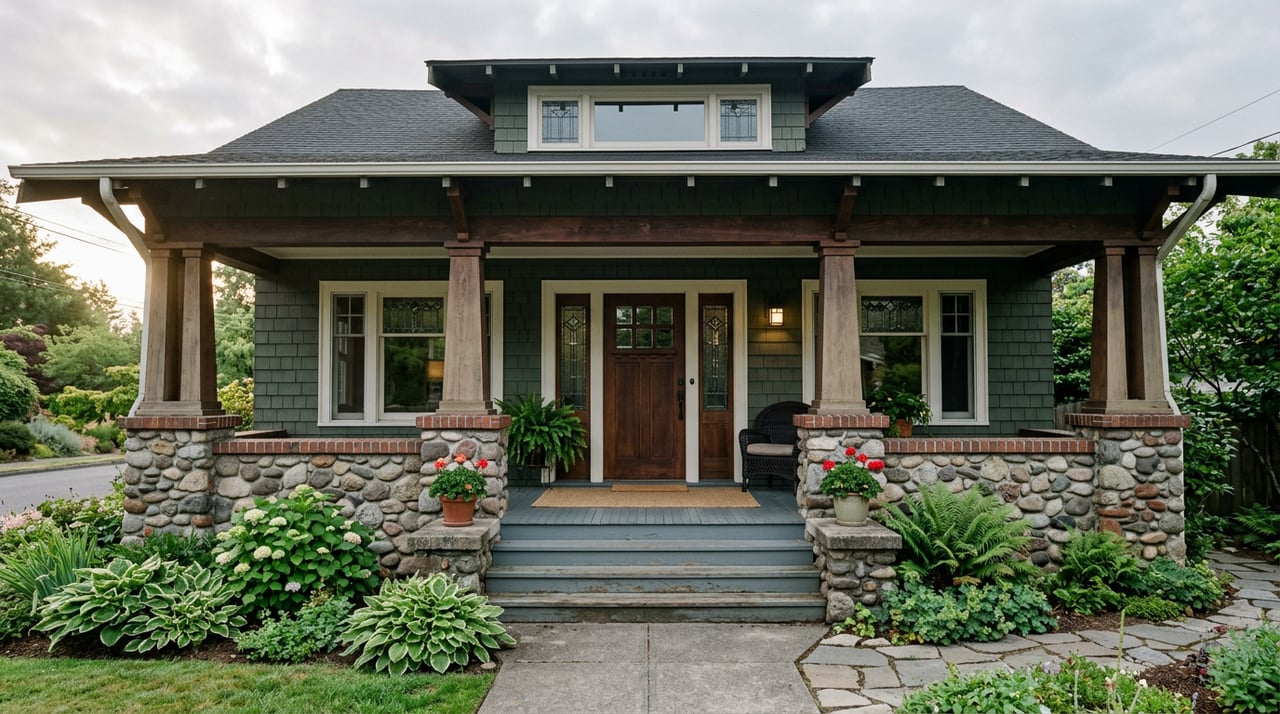
The Fifty-Year Line Running Through Every Old Town Fort Collins Sale
Two houses on the same Old Town block can carry the same square footage, the same lot size, and a nearly identical list price, and still sit on opposite sides of a line that has nothing to do with either number. One was built in 1912. The other went up in 1981. That gap of seventy years puts them on different sides of a threshold that Fort Collins applies to every building in the city, and it happens to be the same threshold that separates the sewer pipe under one house from the sewer pipe under the other.
Fifty years old is the number that quietly does more work in an Old Town transaction than the price on the sign. It decides how you're allowed to change the outside of the house, and it's a rough marker for what kind of pipe is running from that house to the street. Neither the city's permit office nor the ground underneath it care what a portal's median price says about the neighborhood this month. Here's what that fifty-year line actually controls, and why it matters more than the number a buyer sees first.
Fort Collins requires a Historic Preservation Division review for exterior changes to any building fifty years old or older, whether or not that building has ever been designated a landmark. Reroofing, re-siding, replacing windows, adding a dormer, even some fence and porch work can fall under this rule if the structure crosses that age line. The review doesn't automatically make your house a landmark. What it does is put a narrative of your proposed changes, along with exterior photographs and plans, in front of city preservation staff before a building permit can move forward.
If staff and the chair of the Landmark Preservation Commission decide the proposed work is minor, you proceed. If they think the work is substantial enough to raise a landmark question, the property gets a closer look, and a homeowner who disagrees with the outcome has an appeal path through the commission's design subcommittee. None of this requires that anyone nominated your house for anything. It's triggered automatically by age.
This matters in Old Town specifically because the neighborhood's housing stock skews old enough that most of it already crosses the line. Old Town traces back to 1864 as the original townsite, and its bungalows and Victorian-era homes were largely built well before 1976. A buyer planning to update a kitchen, add square footage, or simply replace an aging roof on one of these homes should expect the city's historic review step to be part of the timeline, not an optional add-on for houses with a plaque out front.
The same rough age line shows up again below ground, and it has nothing to do with city code. Fort Collins homes built before roughly 1980 typically run on clay tile or cast iron sewer laterals, the pipe connecting the house to the city main. Homes built after that point were more likely to get ABS plastic, and later PVC, materials that hold up better against the two things that wreck clay pipe over decades: root intrusion and ground movement.
Old Town's mature street trees are part of what makes the neighborhood pleasant to walk through, and they're also the leading cause of sewer line failure that local plumbing crews report in this part of the city. Roots find their way into tiny cracks and joints in old clay pipe seeking water, and once they're in, the pipe only gets worse. Local home inspectors who camera-scope sewer lines in Old Town, along with comparably old pockets of Loveland and Greeley, report finding problems in roughly four out of every ten lines they inspect there. That includes root intrusion, cracked or offset joints, and bellies where the pipe has sagged enough that waste collects instead of draining.
When a lateral fails, repair costs commonly run from around $5,000 into the $20,000 to $25,000 range depending on how much of the line needs to be replaced and whether trenchless methods are an option. That's not a hypothetical line item. It's the kind of repair that shows up mid-inspection period, after a buyer has already fallen for the built-in armoire and the bay window.
| Built before roughly 1976 | Built after roughly 1976 | |
|---|---|---|
| Exterior permit path | Historic Preservation Division review required before permit, regardless of landmark status | Standard permit review, no historic review step |
| Likely sewer lateral material | Original clay tile or cast iron | ABS plastic, later PVC |
| What a sewer scope commonly finds | Root intrusion, cracked joints, or bellies in roughly 4 of 10 scopes reported locally | Lower incidence, though early ABS from the 1980s and 90s is starting to show its own cracking |
| Typical repair cost if it fails | $5,000 to $25,000+ | $5,000 to $25,000+ once a line does fail |
The repair cost lands in a similar range either way once a pipe actually fails. The difference is how likely that failure is, and how much friction sits between you and a simple exterior remodel.
Portal medians for Old Town have been telling two different stories at the same time this year. In the three months ending May 2026, Old Town's median sale price came in around $752,000, down 2.0% from the same period a year earlier. Widen the lens slightly to the overlapping Downtown Fort Collins pocket that some portals track as its own geography, and the three months ending August 2026 showed a median of $645,000, up 8.4% year over year, with average days on market stretching from 29 days a year ago to 110 days this year.
Those numbers are moving in opposite directions, in neighborhoods that overlap on the ground, three months apart. That's not two different markets. It's a small sample size doing what small sample sizes do. Old Town's historic core sells so few homes in any given quarter that the median can swing hard based on which two or three properties happened to close and what condition they were in. One mortgage industry source pricing the neighborhood put its range as wide as $575,000 to $1.75 million, which tells you more about the spread than any single median does.
A median price, whichever version a reader happens to land on, describes the last handful of closings. It says nothing about whether the specific house under consideration was built in 1908 with clay pipe still in the ground, whether a past owner already has Historic Preservation Division sign-off on new windows, or whether the neighbor two doors down just spent $18,000 replacing a collapsed lateral. That's the knowledge a buyer needs before writing an offer, and it lives at the parcel level, not the neighborhood level.
Does the fifty-year review apply only to designated landmarks? No. It applies to exterior changes on any building that has reached fifty years old, whether or not the city has ever formally designated it. Landmark status is a separate, later step that can result from the review, not a prerequisite for it.
What if a past owner already replaced the siding or windows without going through review? That work still happened without the process the city expects, and it can surface later if a future project needs a permit and the city asks for history on the property. It's worth asking the seller directly whether past exterior work was reviewed.
Does every home inspection in Fort Collins include a sewer scope automatically? Not always. It's frequently offered as an add-on rather than a standard line item, which means a buyer has to request it. Given how often older Old Town laterals turn up problems, it's a request worth making rather than assuming it's covered.
An Old Town listing's price tag tells you what the last few sales looked like. It won't tell you whether the exterior work you're planning needs a stop at the Historic Preservation Division first, or whether the pipe under the yard is original clay from the Taft administration. Those are the details that actually price a specific house, and they're exactly what Steve Baumgaertner walks through with buyers and sellers before an offer goes in, not after.


Get assistance in determining current property value, crafting a competitive offer, writing and negotiating a contract, and much more. Contact me today.
Forever Front Range
Address 2720 COUNCIL TREE AVE STE 178 FORT COLLINS CO 80525